
How much information do you really need to justify increasing or decreasing the license totals for your critical and expensive engineering software tools? For many organizations, the answer lies not just in the data, but in the strategy behind how that data is managed and utilized.
The Limitations of In-House Scripts
When faced with license management challenges, some companies choose to build in-house scripts to track usage. Often, this happens when there’s no structured process in place and a single IT professional takes the initiative.
While these scripts can be helpful, IT professionals consistently report that in-house license tracking is:
-
Extremely time-consuming to maintain and update.
-
Dependent on individuals, creating a single point of failure.
-
Limited in scalability, especially as software environments expand.
In organizations without a proper engineering software asset management (eSAM) solution, IT teams often operate reactively — responding to issues instead of proactively managing resources.
Why Many Organizations Paused eSAM & eSAO Initiatives
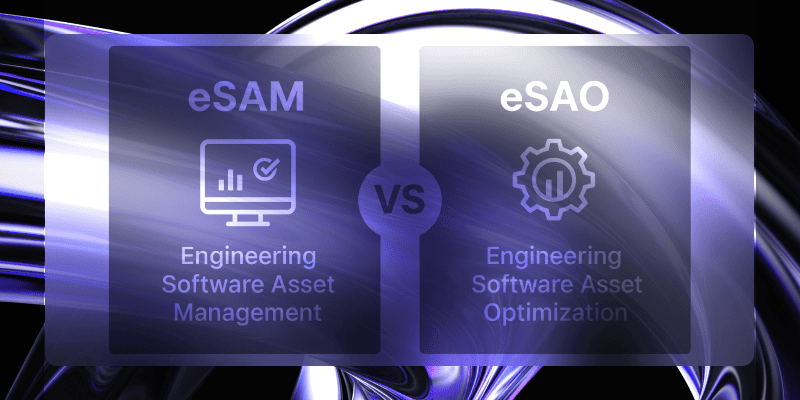
During recent years, many businesses had to redirect resources toward supporting remote work infrastructure and cybersecurity. As a result, eSAM (Engineering Software Asset Management) and eSAO (Engineering Software Asset Optimization) initiatives were temporarily put on hold.
However, as remote work continues to grow, engineering license management is becoming a core part of the remote office strategy. Companies now recognize that visibility, compliance, and license auditing are essential for sustainable operations.
The Rising Importance of License Compliance in Remote Work
The remote work era has made license availability and reliability more critical than ever. When servers fail, even temporarily, the impact can be widespread.
For instance, on Wednesday, November 25, when AWS went down in North America, it disrupted thousands of cloud-based services — including Adobe and Autodesk. Many engineers couldn’t access or log into their tools, halting critical project work.
This real-world scenario highlights the risk of relying solely on vendor-managed or subscription-based licensing without real-time monitoring or backup visibility.
Is Your Company Still Relying on In-House Scripts?
If your organization is still using manual scripts or lacks a proper solution for license oversight, it’s time to rethink your strategy.
Proactive license management not only reduces wasted time and resources but also ensures that expensive engineering tools are fully utilized.
Why You Need LAMUM for Engineering Software Management
LAMUM (License Asset Manager with Usage Monitoring) is a best-in-class solution designed to simplify and optimize engineering software license management. It empowers IT and engineering managers to make data-driven decisions with:
-
Real-time visibility into license usage and denials.
-
Data-backed insights to identify contention or underutilization.
-
Automated alerts for denials, ensuring smoother workflows.
-
Accurate forecasting for increasing or decreasing license counts.
-
Centralized oversight for global or distributed teams.
With LAMUM, your organization can move from a reactive to a strategic, proactive approach — gaining full control over license allocation, usage, and compliance.
Building a Smarter eSAM & eSAO Framework
To stay competitive in today’s fast-paced engineering environment, your eSAM/eSAO strategy must evolve. The goal isn’t just compliance — it’s about efficiency, foresight, and scalability.
By implementing tools like LAMUM, organizations can:
-
Streamline engineering software management.
-
Optimize license usage across regions and teams.
-
Reduce downtime and audit risk.
-
Empower decision-makers with accurate, actionable data.
Start Taking Control of Your Engineering Licenses
Whether you’re managing CAD, EDA, or other complex engineering tools, visibility is everything. Don’t let outdated scripts or fragmented systems slow you down.
Start your free 30-day trial of LAMUM today and see how proactive engineering license management can help your organization save time, improve compliance, and optimize spending.

- Why 24/7 License Activity Reporting Matters for Engineering Teams - August 24, 2026
- Exa Capital Named to the Inc. 5000 List for the Second Consecutive Year - August 17, 2026
- How LAMUM Supports Hybrid and Remote Engineering Teams - July 27, 2026