
When teams rely on home-grown code for license management, the risks can quietly accumulate over time. Understanding the principles of software license management is the first step toward a more strategic approach.
Many companies have had specialists write home-grown code. It was was written long ago and has been in use for some time. Although limited, perhaps out of date, it is installed and working, and probably doesn’t cost anything. But what are some considerations?
Key Questions to Evaluate Your Home-Grown Code Solution
The Hidden Risks of Home-Grown Code
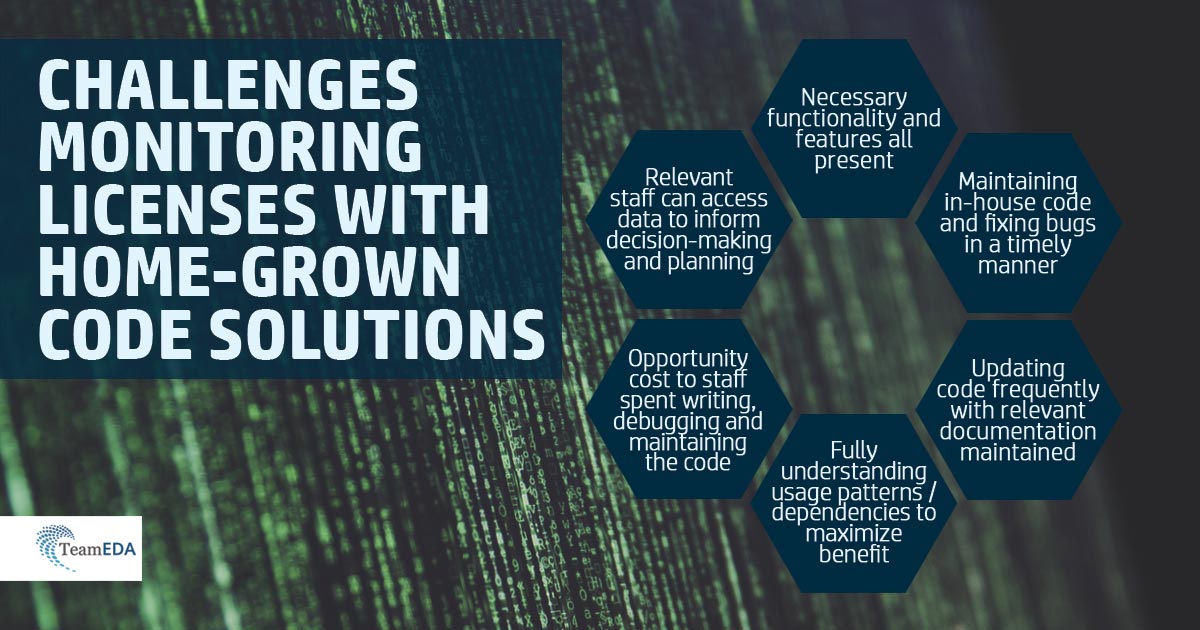
- What functionality are you missing and how important are those features?
- How many are using the home-grown code (getting reports)? Should other people be using it and if so, why aren’t they using it?
- Can anyone support the code? Are there bugs? What is the risk of not having someone around to maintain the code?
- When was the last update? Is there any documentation? If so, is the documentation up to date?
- What are the Opportunity costs of having someone work on this code, vs. doing other things more important? We assume maintaining license monitoring code is not why they were hired. We assume there are important projects they could be working on.
- Are you realizing the greatest possible benefit, like saving the most possible, like fully understanding usage patterns and dependencies? If not, what are you missing?
Explore the broader challenges license management teams face when maintaining in-house scripts for license tracking.
According to IAITAM, purpose-built SAM tools significantly outperform in-house scripts in compliance accuracy and reporting depth.
You can learn more about how home-grown and DIY solutions for license monitoring compare to LAMUM in our White Paper on the topic.
See how lamum vs in-house scripts tools compares across key features and long-term value.


- What Is Elastic Licensing? The Model, the Math, the Trade-offs - October 20, 2026
- License Server vs. License Manager: What’s the Difference? - October 13, 2026
- What Is DSLS? The Dassault Systèmes License Server, Explained - September 29, 2026