
This blog is part of TeamEDA’s broader resource on software license management. If you are new to the topic, that is a good place to start before diving in here.
In today’s competitive world of product development, every organization’s structure, from its teams to its technology stack, influences how efficiently products move from concept to market. Yet, as divisions evolve and companies grow, one key challenge often goes unnoticed: engineering license management.
How Structure Shapes Software Decisions
There are countless ways that teams and divisions can be structured — and this directly affects the software they adopt. Each product line, operating with its own goals and leadership, often chooses tools that best suit its immediate needs. Over time, this results in a fragmented engineering environment, where license management becomes both complex and costly.
Let’s take an example:
-
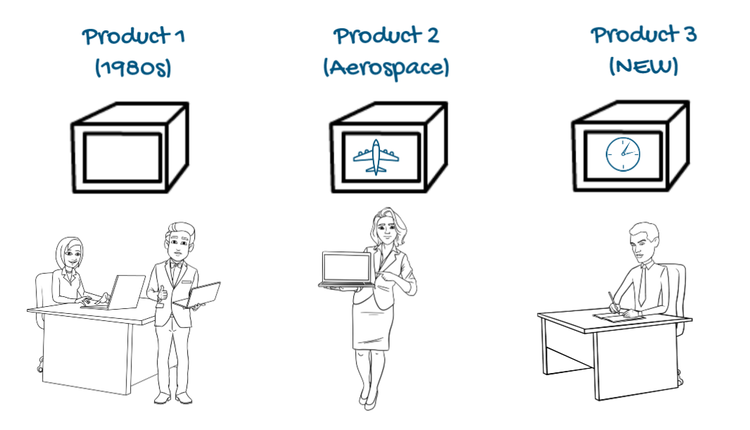
Product 1 has been running since the 1980s. The team began with PTC Pro Engineer, the first tool to introduce parametric modeling. Excitement at the time led them to stay loyal to it for decades.
-
Product 2, focused on Aerospace, adopted Catia, given its dominance in that industry.
-
Product 3, on the other hand, was under pressure to meet a tight development schedule. To save costs and leverage existing expertise, the director opted for Autodesk Inventor.
Meanwhile, the manufacturing department relied on AutoCAD for 2D designs, and subcontractors preferred Siemens NX. The result? A patchwork of tools across departments — each valuable in isolation but inefficient when viewed collectively.
The Problem with Fragmented Engineering Tools
This decentralized approach led to several long-term challenges:
-
Limited visibility into license usage and renewals.
-
Difficulty forecasting needs, as each department operated independently.
-
Inefficient license utilization, with many expensive tools underused.
-
Data silos, as CAD files existed in incompatible formats.
-
Training gaps, since engineers had to learn multiple systems to collaborate across departments.
Eventually, leadership had to face a difficult but necessary question:
“What is the best way to rationalize and optimize all our engineering licenses?”
When Mergers & Acquisitions Add Complexity
Corporate evolution through mergers and acquisitions (M&A) often adds another layer of complexity. When two organizations merge, they frequently bring along different software vendors, license models, and workflows.
While M&A aims to create economies of scale, integrating multiple engineering environments can become a major operational bottleneck. Leaders must decide how to:
-
Consolidate licenses across platforms and departments.
-
Standardize tools to improve collaboration and training efficiency.
-
Optimize costs by eliminating redundancy.
Without a unified strategy, organizations risk overspending on unused licenses and under-equipping teams that actually need them.
Rethinking Engineering License Management
To overcome these inefficiencies, organizations need a centralized engineering software asset management (eSAM) system — one that gives full visibility, control, and insight into software usage and performance.
That’s where LAMUM (License Asset Manager with Usage Monitoring) comes in. LAMUM helps engineering and IT leaders:
-
Track license usage across departments in real time.
-
Identify underutilized licenses to optimize renewals and purchases.
-
Enable data-driven decisions about tool consolidation and future needs.
-
Reduce administrative overhead by automating license tracking.
-
Maintain compliance with vendor agreements and audit requirements.
With LAMUM, you can move from a reactionary to a proactive license management model — one where engineering productivity and financial control work hand in hand.
Questions Every Engineering Leader Should Ask
Before rethinking your software roadmap, consider these questions:
-
Which CAD or engineering system will best support cross-department collaboration?
-
How many licenses do you truly need — and are they being fully utilized?
-
What are the total costs associated with your current tool stack?
-
How can you improve visibility and efficiency without disrupting workflows?
Answering these questions can be the first step toward building a smarter, more sustainable engineering ecosystem.
Conclusion
As your organization grows — through new product lines or corporate mergers — the complexity of managing engineering tools grows with it. But with the right engineering license management strategy, you can cut waste, improve collaboration, and enable smarter, data-driven decisions that move your business forward.


- What Is Elastic Licensing? The Model, the Math, the Trade-offs - October 20, 2026
- License Server vs. License Manager: What’s the Difference? - October 13, 2026
- What Is DSLS? The Dassault Systèmes License Server, Explained - September 29, 2026