
When organizations move from floating license pools to named-user licensing, the transition is usually sold as a simplification. One seat, one person, clear accountability. No more queuing. No more license server contention. On paper, it looks like the messy, hard-to-manage era of concurrent licenses is finally behind you.
Then the renewal invoice arrives, and the number on it is just as large as it was before – sometimes larger. And when someone asks how many of those named seats are actively being used, the room goes quiet.
That silence is the visibility gap. And in named-user license environments, it is both more expensive and harder to detect than anything a floating pool ever produced.
Why Named-User Licensing Feels Simpler Than It Is
The logic behind named-user licensing is sound. Assign a software license to a specific individual, tie it to their identity, and you have a clean record of who owns what. Vendors like it because it closes the loopholes that concurrent licensing left open. Organizations often accept it because the procurement story is straightforward. Headcount drives seat count.
The problem surfaces in the space between assigned and used.
In a floating license environment, the license server is a live record. Every checkout, every denial, every idle session is logged. A license that nobody is using shows up in the server data as exactly that – idle, measurable, visible. An administrator with the right tools can identify it within days and act on it.
In a named-user license environment, that signal disappears. A seat assigned to an engineer who changed projects three months ago, or who uses the tool once a quarter for a specific review cycle, or who left the organization and whose account was never deactivated. None of that generates a denial event. None of it creates queue pressure. The license just sits there, assigned and forgotten, while the subscription renews automatically at full price.
Goodhart’s Law states that when a measure becomes a target, it ceases to be a good measure. Organizations that track license compliance purely by assignment records fall into exactly this trap. Assignment is not usage. It never was. But in named-user environments, it is the only number anyone is watching.
The Three Places Waste Hides in a Named-User License Environment
Understanding where the visibility gap actually lives makes it possible to close it systematically rather than through guesswork.
1. The inactive user problem
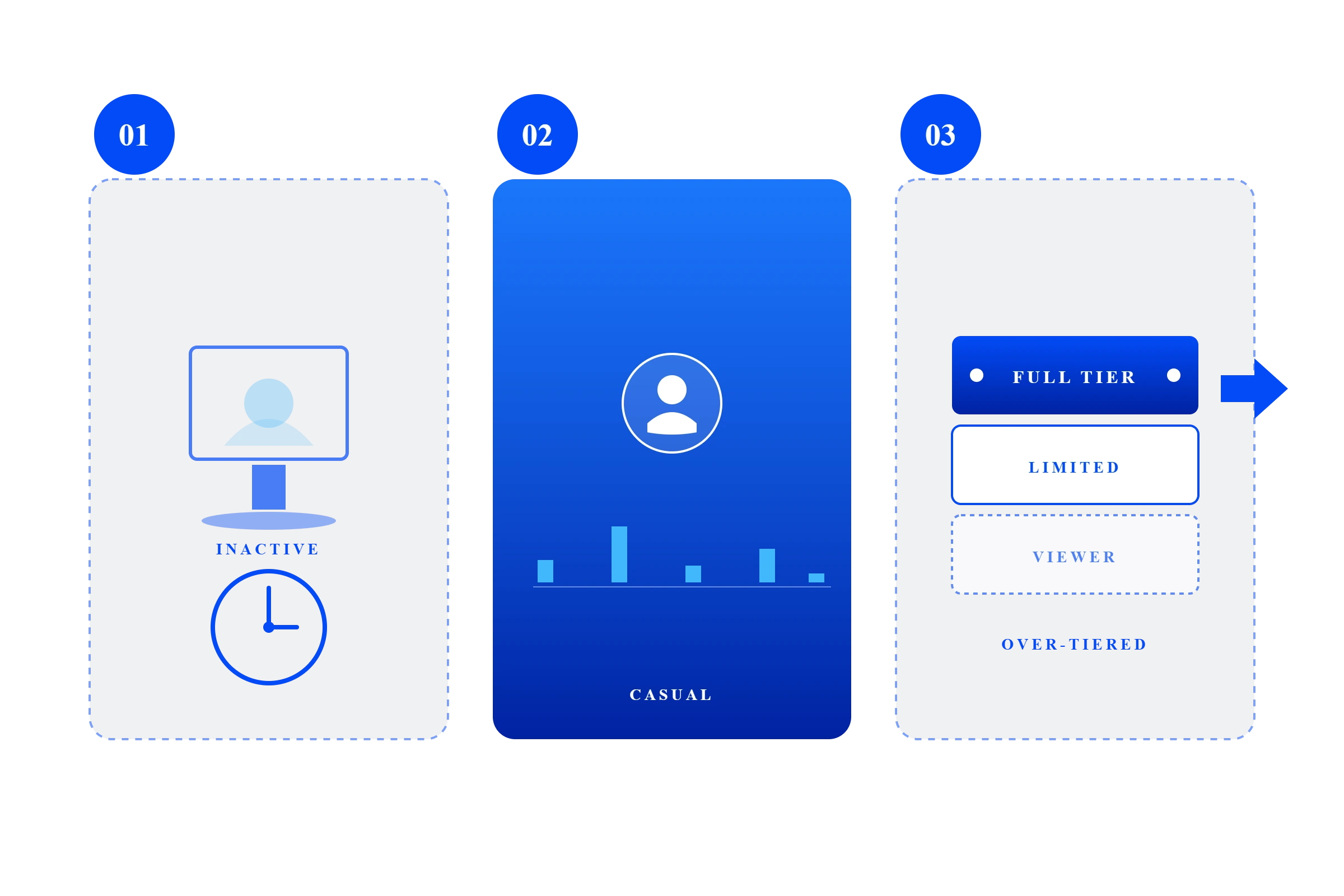
Engineer offboarding processes in most organizations are not perfectly synchronized with software license administration. An engineer leaves, their network access is revoked, but their named-user software license assignment lingers in the vendor portal for months. At times, it lingers for the full term of the subscription. At enterprise software pricing, even a handful of these per year represents real, recoverable cost.
2. The casual user problem
Not every engineer who holds a named-user seat uses the software with the same frequency or intensity. Some use it daily. Others open it once a month for a specific task that could, with proper analysis, be handled through a lower-cost license tier or a shared access model. Without device-level usage data such as, actual activation records, session durations, and CPU utilization, there is no way to distinguish the power user from the occasional user. Both look identical in an assignment-based compliance report.
3. The wrong-tier problem
Many engineering software vendors offer multiple license tiers within their named-user model: full commercial seats, limited-feature seats, viewer-only access, and various combinations. Organizations that procured named-user licenses during a rapid headcount expansion frequently end up with a significant portion of their users on full commercial seats who only need viewer or limited-feature access. The cost difference between tiers can be substantial, and without usage data to map actual feature consumption to license type, the over-provisioning persists indefinitely.
What the License Server Doesn’t Tell You Anymore
This is the part of the named-user transition that catches most license administrators off guard, because the tooling assumption they carried over from floating license management no longer holds.
In a floating license environment, the license server, whether FlexLM, LM-X, Sentinel RMS, or another manager, is the source of truth. It records checkouts and returns. It logs denials. It tracks concurrent usage against the pool ceiling. A capable software license manager built for engineering environments reads that server data and surfaces the patterns that matter: peak demand windows, idle sessions, users consistently hitting capacity limits.
Named-user licensing shifts the record-keeping to the vendor’s identity and entitlement platform. The license server, in the traditional sense, is no longer in the picture. And the vendor portal, while accurate about who holds a seat, tells you nothing about whether that person is actually using the software, how often, for how long, or with what intensity.
This is not a vendor oversight. It is an architectural consequence of the model. The vendor’s obligation ends at entitlement management. Usage intelligence is your problem to solve.
For organizations that have not updated their software license management approach to account for this shift, the gap between what they are paying for and what their engineers are actually using grows wider with every renewal cycle – silently, without producing a single denial event or queue alert to signal the problem.
The Measurement Problem and How to Think About It
Peter Drucker’s observation “you can’t manage what you can’t measure,” gets quoted so often in business contexts that it has lost its edge. In named-user license environments, it is precisely accurate.
The measurement gap in these environments is not a data shortage. Organizations have plenty of data: vendor portal records, identity system logs, procurement histories, IT asset inventories. The gap is in the right kind of data – device-level evidence of whether the software is actually running, for how long, and with what resource consumption. Without that, every optimization decision defaults to either headcount assumptions or political negotiation between departments, neither of which produces reliable results.
The engineering organizations that close this gap do it through agent-based monitoring at the client device level. Rather than relying on server-side check-out records that no longer exist in named-user environments, agent-based approaches track software process activation, session duration, idle state detection, and CPU utilization directly on the machines where the software runs. This produces the usage evidence that assignment records cannot provide. And it does so continuously, not just at audit time or renewal season.
With that data in hand, the named-user license environment becomes manageable in a way it simply cannot be without it. Inactive seats become visible and recoverable. Casual users become identifiable candidates for tier optimization. Feature usage patterns become the basis for license procurement decisions rather than headcount projections.
What Good License Management Looks Like in a Named-User World
The engineering organizations that manage named-user license environments effectively share an approach worth understanding in concrete terms.
They separate entitlement records from usage records and treat both as essential. The vendor portal tells them who holds a seat. Device-level monitoring tells them whether that seat is earning its cost. Both inputs are required; neither is sufficient alone.
They run utilization reviews on a defined schedule rather than waiting for a renewal deadline to force the conversation. A quarterly review cycle, built on actual usage data rather than manager estimates, consistently surfaces optimization opportunities that would otherwise compound into next year’s inflated renewal baseline.
They classify their user population by actual consumption behavior: daily active users, periodic users, and effectively inactive holders. They use that classification to drive both procurement decisions and vendor negotiations. Walking into a renewal conversation knowing that 22% of your named-user seats had fewer than five activation events in the past six months is a fundamentally different negotiating position than arriving with a headcount number and a gut feeling.
Moreover, they apply the right tooling for the environment they are actually running. The hidden costs of unused engineering software licenses in named-user environments are not visible through license server logs or vendor portal reports alone. Closing the visibility gap requires a solution that reaches to the device level. It need a solution that monitors the license environment as it actually operates, not as it was designed to operate a decade ago under a different licensing model.
Closing the Gap Before the Next Renewal
Named-user licensing is not going away. The major engineering software vendors like Autodesk, Siemens, PTC, and Dassault Systèmes have moved the majority of their portfolios in this direction, and the transition will continue. The organizations that adapt their license management approach to match the new environment will recover meaningful spend and negotiate from a position of knowledge. Those that carry over their floating-license-era assumptions into named-user environments will keep renewing at headcount, keep paying for inactive seats, and keep leaving optimization opportunities on the table.
The visibility gap in named-user environments is real, it is measurable, and it is closeable. The first step is admitting that assignment records and usage records are two different things. And that you need both.
An Opportunity to Close That Gap
If you are managing named-user engineering software licenses and want to understand what your current usage data actually looks like, LAMUM’s add-on Agent Monitor capability was built for exactly this environment. See what is running on your engineers’ machines, and what isn’t, before your next renewal conversation.
Explore Agent Monitor!

- What Is Elastic Licensing? The Model, the Math, the Trade-offs - October 20, 2026
- License Server vs. License Manager: What’s the Difference? - October 13, 2026
- What Is DSLS? The Dassault Systèmes License Server, Explained - September 29, 2026